


 By
By 
Emerging markets (EM) are often cast as riskier or more volatile than developed markets, but geopolitics and policy changes are reshaping this narrative and investors are taking notice. While portfolio diversification and valuations are strong pull factors, forecasts that many core EM economies are in the early innings of a multi-year virtuous economic cycle should accelerate investor demand for EM debt, in our view.
“Golden era”
In the post-Covid years, we have seen many core EM economies implement positive structural reforms and adhere to disciplined monetary policy and fiscal rules. Interconnected factors—some consecutive, others simultaneous—have fostered an optimism that we believe could translate into a golden era for EM whereby credible policies support a more stable economic backdrop, attracting capital inflows and driving domestic investment, productivity and earnings gains, all of which support greater optimism.
Cultivating positive momentum
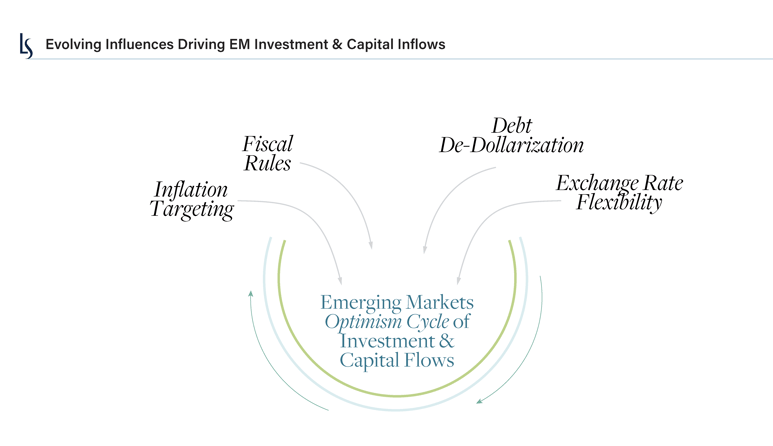
No one dynamic accounts for the favorable progression underway in EM. In fact, we find that there are a variety of constantly evolving influences.
Accommodative policies
For example, having systematically imposed timely monetary policies that addressed pricing pressures, EM countries are now posting inflation levels within established targets. Benign inflation conditions have, in turn, allowed policy rate cuts, which have eased domestic financing costs and supported growth.
Fiscal policy, flexible exchange rates and debt de-dollarization
Fiscal policy in many core EM countries has progressed toward well-defined fiscal targets, with built-in flexibility to address shocks. With EM central banks more focused on internal inflationary pressures, the use of valuable reserves to defend currencies has waned. Efforts to right-size the use of external debt funding in favor of local markets has allowed both government entities and the business community to raise debt financing without currency mismatch, reducing concerns about the implications of currency swings on borrowing costs and debt sustainability. Combined, these policies help contribute to the stabilization of the economic backdrop.
External factors
Emerging economies have certainly been helped by global drivers. The moderation in oil prices has continued to reinforce deflationary trends. With many EM countries net importers of oil, we believe oil prices ranging in the mid-$60s are favorable—high enough for exporters and manageable for importers. At the same time, the weaker US dollar is providing tailwinds for EM economies by easing the domestic debt burden and reducing the strain on fiscal accounts.
Closing the loop
Stronger economic fundamentals and attractive carry opportunities should reinforce capital inflows and therefore a positive feedback loop, in our view. Capital inflows, combined with lower borrowing costs, stand to benefit growth outlooks for EM economies. Longer term, we believe EM demographic advantages, the global green transition and accelerating digitalization should underpin long-term structural demand in EM economies and lend support to the EM growth story.
In this evolving environment where investors are seeking opportunities with favorable growth prospects and compelling valuations, we believe EM debt represents an attractive universe for building diversified portfolios. With a wide range of investment grade and high yield options across sovereigns and corporates, portfolios can be tailored to meet specific yield and return goals in line with an investor’s risk tolerance.
WRITTEN BY:
Elisabeth Colleran, CFA, Portfolio Manager, Co-Head of the Emerging Markets Debt Team
Jackie Lafferty, Investment Strategist

8645139.1.1
Diversification does not ensure a profit or guarantee against a loss.
Past performance is no guarantee of, and not necessarily indicative of, future results.
Market conditions are extremely fluid and change frequently.
This blog post is provided for informational purposes only and should not be construed as investment advice. Any opinions or forecasts contained herein reflect the
subjective judgments and assumptions of the authors only and do not necessarily reflect the views of Loomis, Sayles & Company, L.P. Information, including
that obtained from outside sources, is believed to be correct, but Loomis Sayles cannot guarantee its accuracy. This material cannot be copied, reproduced or
redistributed without authorization. This information is subject to change at any time without notice.