


 By
By With global banks frequently in the headlines, it’s important that credit investors recognize which factors are more likely to influence bond spreads and those that are not—at least for now.
In our view, with profitability so strong right now, quarterly earnings should have less impact on spreads. Even if profitability declines a little bit, it is still well above where it has been for the past decade. Additional once-meaningful factors that we see as unimportant include the UK motor finance scandal, tariffs, liquidity and commercial real estate exposure.
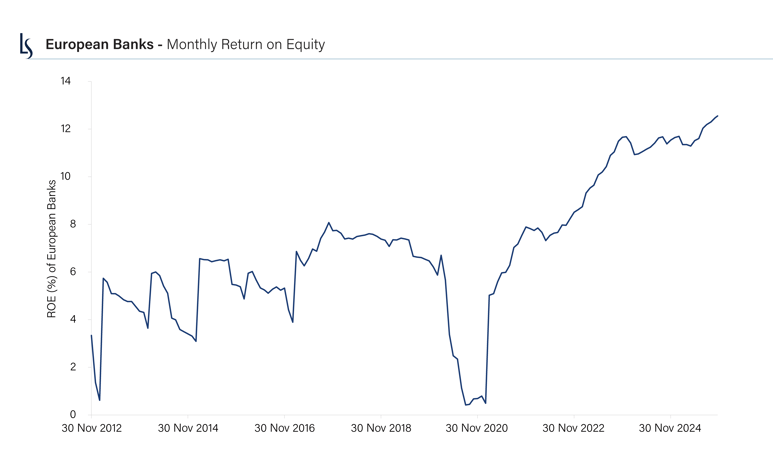
Source: Bloomberg, Euro Stoxx Banks Index as of 19 November 2025.
The chart presented above is shown for illustrative purposes only. Some or all of the information shown may be dated, and, therefore, should not be the basis to purchase or sell any securities. The information is not intended to represent any actual portfolio managed by Loomis Sayles.
In contrast, we foresee developments in the following categories as having the potential to move bond spreads tighter or wider.
Sovereign ratings
In our view, rating agencies have been looking more at sovereign rating changes than individual bank fundamentals when considering bank rating changes. In many cases, rating changes have not been made on a case-by-case basis. Instead, wholesale changes have been made to numerous banks based on domicile and exposure to certain countries. For example, all banks domiciled in Italy, Spain, Portugal, and Greece have been upgraded and are likely to see continued upward momentum for ratings going forward. On the other hand, French banks have avoided downgrades so far, but we expect this will change over time as downward pressure on the French sovereign persists.
Politics
Political leaders and their decisions are substantially influencing bank bond spreads. This includes new prime ministers in France and Japan, any change to projected budget deficits in the UK and France and the implications of volatile US-China relations on Asia-focused UK banks. Increasing far-right influences in France, Germany and the Netherlands also have the potential to impact economic growth, bank fundamentals and bond spreads as upcoming elections roll on.
Litigation
Litigation for large global banks is part of the normal course of business and is usually just background noise. We believe recent litigation involving two large global banks should be manageable, but potential tail risks could move spreads, or at least prevent outperformance until we get more clarity. Even manageable losses can erode margins of safety and leave banks vulnerable to anything else unexpectedly going wrong.
Mergers and acquisitions (M&A)
With stock valuations returning to more normalized levels after years of price-to-book ratios below 1x, we expect M&A to remain active. While M&A is not without execution risk and ill-timed acquisitions have historically been one of the leading causes of bank failures, we generally view M&A as positive for bondholders. This is because large M&A can provide scale and diversification and are usually funded by the issuance of new shares. The problem now is that local politicians are directing M&A instead of letting traditional market forces decide, which has the potential to end badly.
Asset quality
Thus far, domestic consumer-related lending shows no signs of stress in the domestic markets of global banks and we expect that will continue. However, global banks do have exposure to chunky, one-off corporate losses that have made headlines in the US and elsewhere, especially those banks with large global corporate and investment banking businesses.
Capital
Overall, global bank capitalization is very strong and could be considered less important as a factor given how much improvement there has been. Aggressive financial policy in the form of increasing dividends and buybacks is not new for global banks, but so far, increasing profitability has been an offset to prevent any real deterioration in capital. As profitability normalizes under lower interest rates, we will need to closely watch how much lower capitalization moves.
Takeaway
It’s not always the most topical development that analysts have to weigh. We believe avoiding distracting headlines is critical in assessing meaningful factors with the potential to drive global bank credit spreads tighter or wider.

8645105.1.1
Market conditions are extremely fluid and change frequently.
This blog post is provided for informational purposes only and should not be construed as investment advice. Any opinions or forecasts contained herein reflect the
subjective judgments and assumptions of the authors only and do not necessarily reflect the views of Loomis, Sayles & Company, L.P. Information, including
that obtained from outside sources, is believed to be correct, but Loomis Sayles cannot guarantee its accuracy. This material cannot be copied, reproduced or
redistributed without authorization. This information is subject to change at any time without notice.